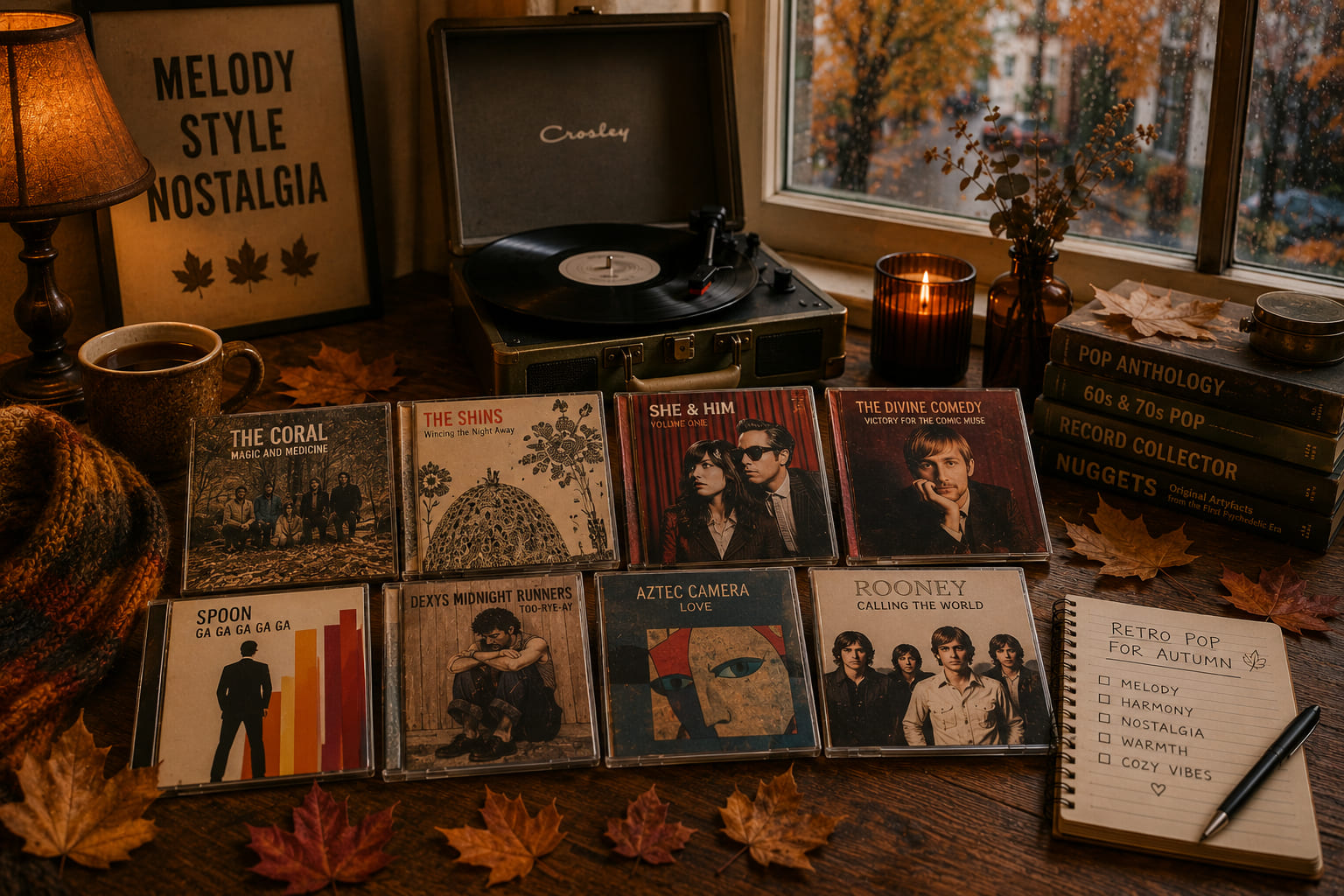
Autumn changes the way many people listen. Bright, fast records can still work, but shorter days often make room for warmer arrangements, reflective lyrics, acoustic instruments, and melodies that carry a little uncertainty. Retro pop is especially suited to that shift because its best albums rarely separate comfort from melancholy.
This guide is not a list of records that mention falling leaves. It focuses on sound: muted brass, close vocals, woody guitars, chamber strings, tape-softened drums, and songs that reward listening from beginning to end.
For the first cool evenings: The Zombies — Odessey and Oracle
Odessey and Oracle balances color and restraint. Mellotron, piano, organ, acoustic guitar, and close harmony create a detailed surface, yet the record never feels oversized. Its songs move between hope, memory, war, separation, and renewal.
“Care of Cell 44” begins with anticipation, while “Brief Candles” and “Maybe After He’s Gone” lean toward reflection. “This Will Be Our Year” offers warmth without pretending that warmth is permanent. That emotional range makes the album ideal for the point when summer is still visible but already receding.
For golden afternoon light: Love — Forever Changes
Forever Changes uses acoustic guitars, brass, strings, and unsettling lyrics to create beauty that never feels completely safe. Arthur Lee’s writing observes Los Angeles from a distance, mixing private doubt with social unease.
The arrangements are elegant, but the rhythm section keeps them grounded. Listen to how trumpets and strings answer the vocal instead of simply making the songs larger. The album suits clear autumn days when light remains bright but the mood has changed.
For quiet weekends: Nick Drake — Bryter Layter
Bryter Layter is more arranged and outward-facing than Nick Drake’s other albums. Piano, strings, electric guitar, bass, and guest vocals surround his soft singing without removing its intimacy.
The record works well at lower volume. Small instrumental details emerge gradually, and the melodies do not demand immediate attention. It is a useful example of how orchestration can create comfort while preserving solitude.
For rain against the window: The Left Banke — Walk Away Renée/Pretty Ballerina
The Left Banke’s best-known material turns romantic uncertainty into formal pop drama. Strings, harpsichord, and classically shaped melodies give the songs a cool, suspended quality. Even the brighter moments retain an edge of distance.
This is a natural next step after our comparison of sunshine pop and baroque pop. The record shows the baroque side clearly: instrumental lines and harmonic movement carry as much emotional weight as the lyrics.
For a modern autumn morning: Weyes Blood — Titanic Rising
Natalie Mering’s voice remains calm while the arrangements expand around piano, strings, synthesizers, and layered harmonies. Titanic Rising addresses connection, technology, environmental anxiety, and the desire for stability, making it reflective without becoming closed-off.
Its production is modern, but its patience belongs to the album era. Play it without shuffle. The transitions and recurring colors make the record feel like one continuous emotional space.
For long drives: Teenage Fanclub — Songs from Northern Britain
Teenage Fanclub combine ringing guitars, measured tempos, and plainspoken melodies. Compared with the heavier Bandwagonesque, this album feels more settled and open. The harmonies are warm, but the songs often consider time, loyalty, and the effort required to maintain closeness.
It is a strong choice for listeners who enjoyed the records in our beginner’s power-pop guide but want something less forceful for the season.
For early darkness: The High Llamas — Gideon Gaye
Gideon Gaye surrounds understated vocals with brass, strings, keyboards, and carefully shaped harmonic movement. The album draws from Brian Wilson and orchestral pop, but its pace is unhurried and slightly dreamlike.
Rather than presenting obvious seasonal imagery, it creates an indoor sense of detail. The music feels built from lamps, paper, wood, and old studio equipment. That may sound abstract, but the association becomes clear once its soft instrumental colors settle in.
For late autumn reflection: Big Star — Third
Third is less stable than the usual idea of power pop. Its sequencing has varied across releases, and the performances move between tenderness, collapse, humor, and bare beauty. Strings and piano sometimes appear as fragile supports rather than decoration.
This is not a casual background record. Save it for a night when you can accept its changes in tone. The album’s instability is precisely what makes its quiet moments so affecting.
For warmth without nostalgia: The Lemon Twigs — Everything Harmony
Everything Harmony looks back in style but remains emotionally direct. Acoustic guitars and close vocals recall several earlier traditions, while the songs focus on loneliness, dependence, and attempts at connection.
The record fits autumn because its beauty is active rather than decorative. Harmonies do not erase sadness; they give several voices to it. You can hear more about the group’s recording approach in our guide to modern albums with 1960s production character.
Build an autumn sequence, not a fixed playlist
Try beginning with the brighter records in September and moving toward denser, quieter albums as winter approaches. Odessey and Oracle and Songs from Northern Britain work well early. Forever Changes and Titanic Rising suit the middle of the season. Big Star’s Third belongs near the end.
Volume matters too. Many of these records reveal more at a moderate level, where vocal unity and instrumental texture remain balanced. Headphones can expose details, but speakers allow the arrangements to occupy a shared room.
What these albums have in common
- Warm instrumental tone without constant brightness.
- Melodies that combine reassurance with uncertainty.
- Arrangements that reward complete-album listening.
- Acoustic or orchestral details that create a physical sense of space.
- Songs concerned with time, memory, change, and connection.
Seasonal listening is personal. An album becomes an autumn record because of when and how you live with it. These choices simply provide the right materials: melody, texture, patience, and enough emotional shadow to make the warmth meaningful.