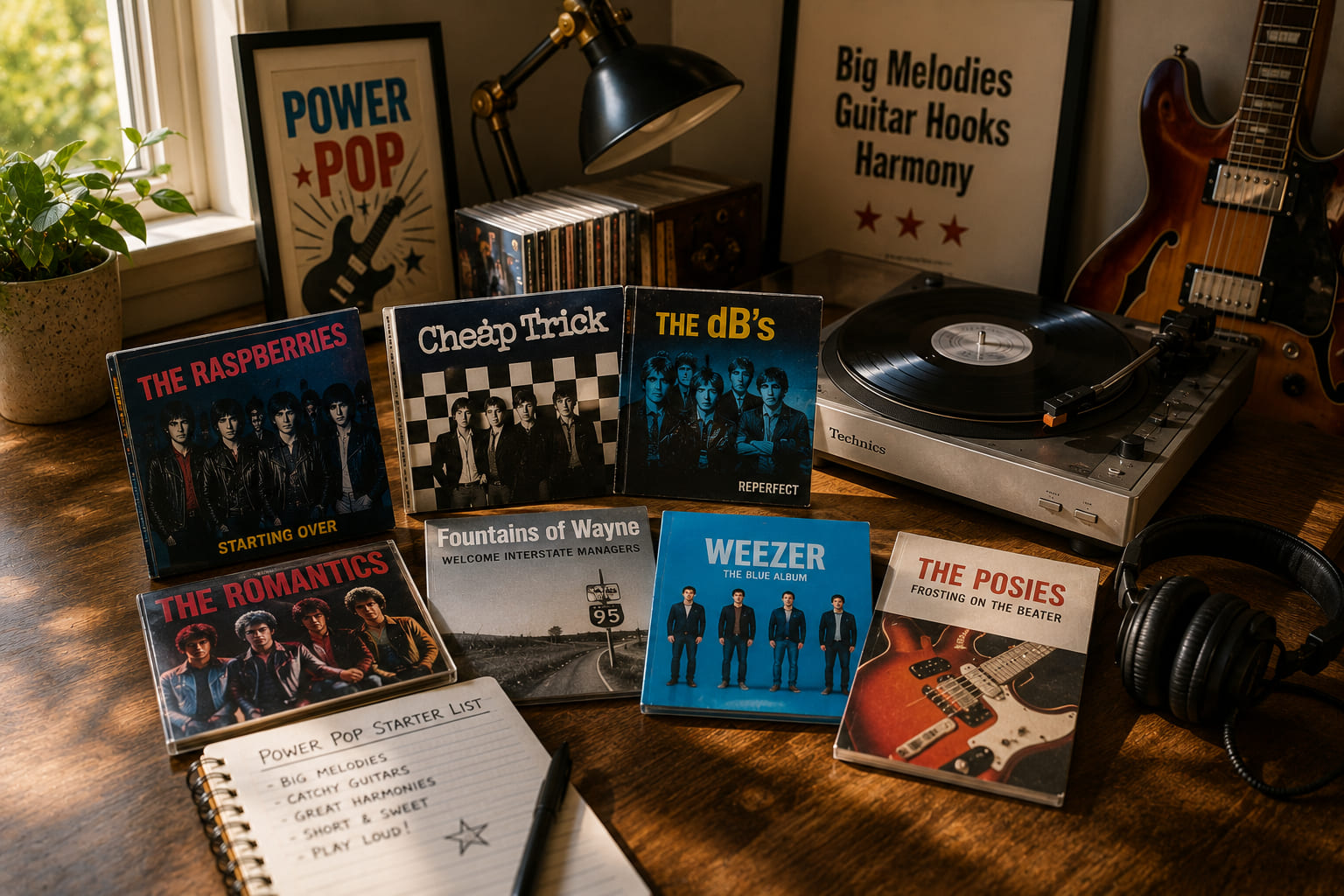
Power pop aims for a difficult balance: the immediacy of a great pop single with the physical energy of a rock band. The guitars may be loud, but the melody must remain clear. The chorus should arrive quickly, yet the song needs enough character to survive repeated listening.
The term covers several generations, from Badfinger and the Raspberries to Big Star, Cheap Trick, Teenage Fanclub, the Beths, and Alvvays. The following albums form a practical listening route rather than a rigid ranking.
Start with the basic formula
Before choosing records, listen for four traits: concise structure, melodic guitar parts, vocal hooks, and rhythmic drive. Power pop can borrow from punk, glam, new wave, or indie rock, but it usually keeps those elements in service of the song.
This separates it from hard rock, where riffs and instrumental force may dominate, and from softer pop-rock, where the guitars may lack the necessary attack. The strongest power pop lets you remember both the chorus and the guitar figure.
Badfinger — Straight Up
Badfinger inherited much from the Beatles but developed a direct emotional style of their own. Straight Up contains ringing guitars, strong middle eights, and choruses that feel inevitable without sounding mechanically simple.
Begin with “Baby Blue” and “Day After Day.” Notice how slide guitar, harmony vocals, and compact arrangements add color without delaying the hook. This album is a good first step because it sits close to classic 1960s songwriting while pointing toward the louder 1970s form.
Raspberries — Fresh
The Raspberries bring greater theatrical force. Eric Carmen’s melodies are broad, the guitars hit harder, and the vocals move between sweetness and urgency. “Go All the Way” demonstrates the central power-pop trick: a forceful opening riff gives way to a smooth, highly singable chorus.
Fresh suits listeners who want the style at its most extroverted. It also shows why power pop should not be confused with timid retro music. The form works when the band commits fully to both sides of its name.
Big Star — #1 Record
Big Star’s debut is the genre’s key cult record. Alex Chilton and Chris Bell combined Beatles and Byrds influences with Memphis recording experience, youthful lyrics, acoustic detail, and electric guitar bite. The album can sound confident one moment and fragile the next.
The Recording Academy’s history of #1 Record describes the group as power-pop pioneers whose brief original run influenced later generations. Listen to “Feel,” “The Ballad of El Goodo,” and “When My Baby’s Beside Me” for three different balances of force and melody.
Cheap Trick — In Color
Cheap Trick sharpened power pop for arenas without abandoning eccentricity. In Color is bright, fast, and economical. Robin Zander’s clear vocal delivery carries large hooks, while Rick Nielsen’s guitar parts add humor and tension.
The original studio mix is lighter than the band’s live reputation, which makes the album useful for beginners. It proves that power does not require an overloaded mix. Arrangement, tempo, and performance can create impact.
The Cars — The Cars
The Cars introduced synthesizers, clipped rhythm guitar, and new-wave cool to the power-pop framework. Their 1978 debut is packed with recognizable hooks, but its production is more controlled and modernist than the earlier records on this list.
Listen to how keyboard parts share space with guitar instead of acting as decoration. The album expands the style’s vocabulary while preserving concise songwriting.
Teenage Fanclub — Bandwagonesque
Bandwagonesque connects Big Star’s melodic vulnerability with the thicker guitar sound of early-1990s alternative rock. Three songwriters and singers give the album variety, but shared harmonies and guitar tone hold it together.
It is an ideal next step after our beginner’s guide to jangle pop, because the album lives between chiming guitar music and fuzzier power pop. “The Concept” and “What You Do to Me” show how repetition becomes affecting when the melody is strong.
Fountains of Wayne — Welcome Interstate Managers
Fountains of Wayne write from close observation. Their songs use specific characters, places, jobs, and disappointments, proving that polished hooks do not require generic lyrics. The album moves beyond its best-known single into country-pop, ballads, and sharply arranged guitar songs.
Choose this record when you want to hear how classic power-pop craft can support adult storytelling and varied production.
The Beths — Future Me Hates Me
The Beths bring the style into a contemporary indie setting. Elizabeth Stokes writes precise, self-questioning lyrics, while the band uses brisk rhythm, harmony vocals, and tightly organized guitar parts.
The record feels energetic because the players interact, not because every sound is maximized. It is a strong example of modern power pop retaining emotional detail.
Alvvays — Blue Rev
Blue Rev is denser and less tidy than the traditional template, but its melodies remain remarkably clear beneath distortion, effects, and rapid arrangement changes. The Recording Academy highlighted the album as a modern expansion of power pop.
Save it for later in the route. Once your ear understands the basic form, Blue Rev reveals how far the style can stretch without losing its melodic center.
A simple listening order
- Straight Up for the bridge from 1960s pop to 1970s guitar music.
- Fresh for the strongest shift between riffs and choruses.
- #1 Record for the genre’s emotional and historical center.
- In Color and The Cars for streamlined late-1970s versions.
- Bandwagonesque for the alternative-rock connection.
- Future Me Hates Me and Blue Rev for current approaches.
Power pop is easy to enjoy and hard to execute. Loud guitars can hide weak writing, while perfect melodies can feel weightless without a committed band. These albums last because they solve both problems at once.
After hearing them in sequence, you will recognize the family resemblance: a guitar rings, the rhythm tightens, and a chorus arrives that feels obvious only because the songwriter found exactly the right shape.