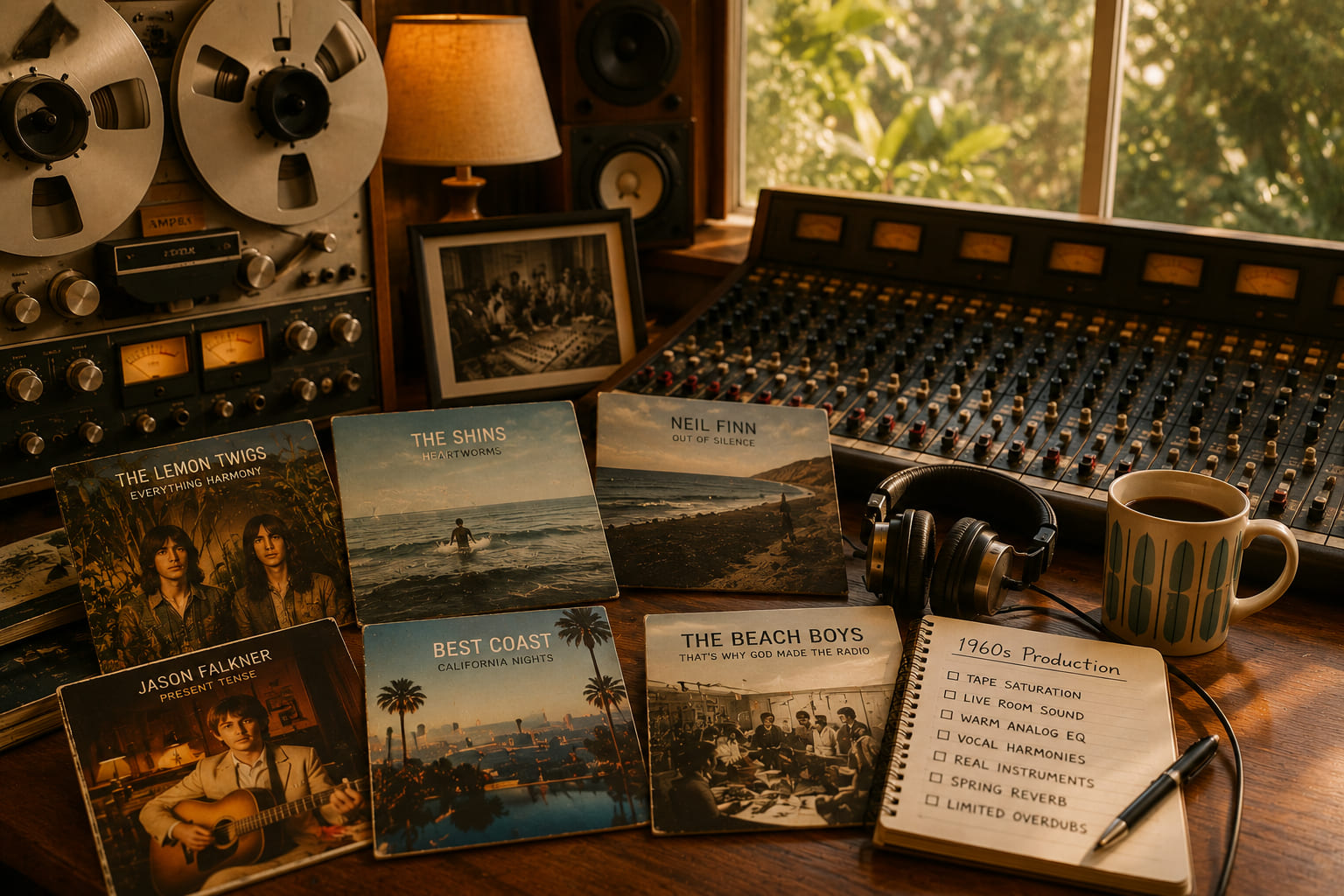
A record can sound inspired by the 1960s without being recorded on equipment from the 1960s. The impression usually comes from a chain of choices: performance style, microphone placement, arrangement, tape-like saturation, limited effects, and a willingness to leave small imperfections in place.
The most convincing modern examples do not apply a single “vintage” filter at the end. They build the sound from the song outward. The albums below use different methods, but each understands that period character begins with musicians, instruments, and arrangement.
What listeners mean by a 1960s sound
The decade contained many production styles, from dry mono soul to wide psychedelic experiments. Still, several traits recur in modern retro-pop: rounded transients, compact drum sounds, prominent midrange, plate or chamber reverb, doubled vocals, acoustic instruments, and mixes that feel cohesive rather than separated into sharply defined layers.
Analogue tape is often part of the discussion. Abbey Road Studios explains that tape overload creates natural compression and distortion known as saturation. Digital tools can imitate that behavior, but the important lesson is restraint. Warmth comes from the relationship between tone, dynamics, and arrangement, not from making every track fuzzy.
Arrangement first: The Explorers Club — Freedom Wind
The Explorers Club treat harmony vocals and instrumental color as parts of the composition. Drums are controlled, guitars avoid excessive brightness, and keyboards, brass, and percussion are arranged in short responses. The result recalls mid-1960s California pop while remaining cleaner than many original recordings.
Listeners arriving from our modern albums for Beach Boys fans will recognize why this record is a reference point. Its period character comes from musical decisions before studio effects enter the picture.
Jacco Gardner — Cabinet of Curiosities
Gardner’s 2013 debut uses harpsichord-like keyboards, Mellotron colors, bass lines with melodic independence, and softly treated vocals. The production suggests psychedelic and baroque pop without becoming crowded. Instruments often appear as small events around the vocal rather than continuous layers.
Pay attention to the low end. The bass is audible and tuneful, but it does not have the deep sub-bass extension common in current pop. That narrower frequency picture helps the record feel older while keeping the arrangements clear.
Psychedelia reshaped: Tame Impala — Lonerism
Kevin Parker combines vintage psychedelic cues with heavily shaped modern sound. The drums are compressed and saturated, vocals sit inside the mix, and synthesizers blur the line between old and new. This is not historical reconstruction. It is a modern producer using traits associated with late-1960s psychedelia as raw material.
That distinction matters. A credible retro record does not need to hide its own decade. Lonerism works because its production supports songs about isolation, overstimulation, and private thought.
Analogue discipline: The Lemon Twigs — Everything Harmony
Everything Harmony favors acoustic guitars, closely matched voices, dry-to-moderate room sound, and arrangements that can change quickly without losing the melody. The brothers’ interest in analogue working methods is well documented; a 2024 Guardian interview described a studio filled with tape and their preference for hands-on musical work.
The record’s strongest vintage quality is not tape noise. It is the way the musicians sing and play together. Phrases breathe, harmonies are performed rather than constructed from identical copies, and arrangements follow emotional changes in the lyric.
Old scale, current clarity: Weyes Blood — Titanic Rising
Titanic Rising uses strings, piano, layered vocals, and broad melodic writing associated with late-1960s and 1970s studio pop. Yet its low end, stereo field, and overall scale are unmistakably modern. It shows how orchestral pop can reference the past without reducing itself to imitation.
The vocal remains calm even when the arrangement grows large. That balance creates authority: the production amplifies the song’s emotional horizon instead of competing with the singer.
Michael Kiwanuka — Love & Hate
Produced by Danger Mouse and Inflo, Love & Hate draws from psychedelic soul, orchestral pop, and long-form album production. Choirs, strings, guitar effects, and steady rhythm sections build gradually. The record often feels cinematic, but its core performances retain a human pulse.
It is a useful reminder that “1960s production” includes more than bright pop. Soul studios, film scores, folk recording, and psychedelic rock all contributed techniques that modern artists can reinterpret.
Shannon and the Clams — Onion
This album approaches retro sound from a rougher direction. Garage-rock attack, girl-group drama, organ, and vocal reverb create a heightened emotional style. The production allows grit and pitch character to remain visible, which gives the songs personality that excessive correction would remove.
How to hear the production choices
- Listen to the drum attack: is it sharp and modern, or rounded and compact?
- Notice whether vocals sit in front of the band or merge with the instruments.
- Check how much deep bass and extreme treble the mix contains.
- Identify real arrangement changes before assuming an effect created the mood.
- Compare repeated choruses for small performance differences.
You can hear these details more clearly by playing a modern retro album beside an original 1960s recording at a similar volume. The newer record will often have deeper bass, lower noise, and greater stereo precision. What connects them is usually the treatment of performance and arrangement.
The best period-inspired production serves the song. It may borrow tape color, chamber reverb, or mono-style balance, but it avoids turning history into a costume. That is why these albums feel lived-in rather than staged.