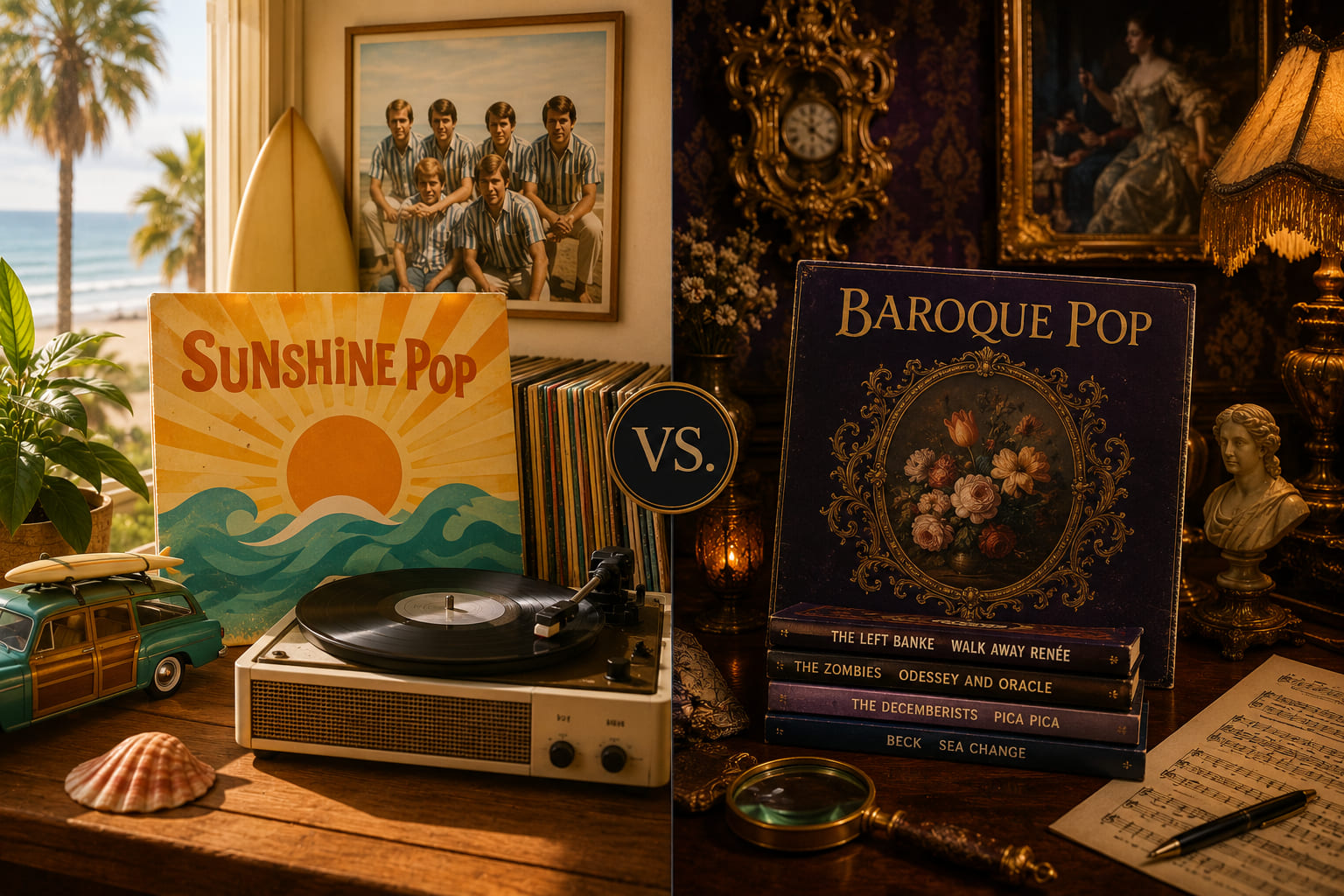
Sunshine pop and baroque pop are often grouped together because both reached prominence in the 1960s and both use polished arrangements beyond a basic guitar-bass-drums setup. A single song may belong to both. Still, the terms describe different priorities, and learning the distinction makes it easier to find the records you actually want.
Sunshine pop is usually defined by vocal warmth, optimistic or wistful atmosphere, and smooth studio craft. Baroque pop is identified more by orchestral color, classical references, and dramatic harmonic movement. One points first to mood; the other points first to arrangement language.
A quick comparison
- Sunshine pop: bright vocal unity, soft rhythmic lift, polished production, and an idealized or bittersweet mood.
- Baroque pop: strings, harpsichord, oboe, brass, counterpoint, unusual chord movement, and a more formal or dramatic character.
- Shared ground: melody, layered arrangements, studio experimentation, and roots in mid-1960s pop.
What makes a record sunshine pop?
Sunshine pop grew mainly from American studio pop, especially the California scene. It drew from the Beach Boys, folk pop, easy listening, commercial songwriting, and the sophisticated production associated with Los Angeles session musicians. Groups such as the Mamas and the Papas, the Association, the Millennium, Sagittarius, and the Free Design are commonly connected with the style.
The name can be misleading. Not every song is carefree. Sunshine pop frequently places anxious or lonely lyrics inside glowing harmonies. The tension is part of its appeal: voices promise togetherness while the individual singer may sound uncertain.
The genre’s historical overview notes its overlap with baroque pop, folk pop, and Brill Building writing. That overlap explains why strict classification becomes difficult. A record can use strings and harpsichord while still feeling primarily like sunshine pop because vocal atmosphere remains its central feature.
What makes a record baroque pop?
Baroque pop combines pop or rock songwriting with selected ideas and timbres associated with classical music. Harpsichord is the obvious sign, but it is not the only one. String quartets, oboes, French horns, contrapuntal lines, formal introductions, and unexpected harmonic turns can all contribute.
The Left Banke’s “Walk Away Renée,” the Zombies’ Odessey and Oracle, and portions of the Beatles’ Revolver and Sgt. Pepper era provide useful reference points. Burt Bacharach’s writing also shaped the wider vocabulary through elegant melodies, orchestration, and rhythmic surprise, even though his work does not fit neatly inside one rock genre.
Baroque pop often has a more theatrical emotional profile than sunshine pop. It can feel stately, melancholic, mysterious, or suspended between pop directness and chamber-music formality.
The easiest test: follow the arrangement’s center
Ask what you would miss most if one element disappeared. If removing the layered voices destroys the song’s identity, sunshine pop may be the better description. If removing the string figure, harpsichord pattern, or contrapuntal instrumental line changes the composition fundamentally, baroque pop is probably more useful.
This is not a scientific rule. It is a listening tool. Genre terms work best when they guide attention rather than police boundaries.
Where the Beach Boys fit
The Beach Boys are central to sunshine pop because of their vocal architecture, California imagery, and studio ambition. Pet Sounds also contains orchestral and chamber-like features that overlap strongly with baroque pop. The Library of Congress essay on Pet Sounds describes Brian Wilson’s layered recording process and the album’s carefully planned construction.
That combination helped later artists imagine pop as a complete arranged environment. If you are interested in the emotional and seasonal side of that sound, read why some pop songs feel like summer. If production is your main interest, our guide to modern 1960s-inspired production follows the studio approach forward.
Three pairs that reveal the difference
The Association and the Left Banke
The Association often foreground smooth group singing and an airy West Coast finish. The Left Banke place more weight on strings, harpsichord, and classically shaped melancholy. Both are melodic, but their centers of gravity differ.
Sagittarius and the Zombies
Sagittarius records often create a carefully manufactured sunshine atmosphere through studio voices and polished arrangements. The Zombies sound more like a self-contained band whose keyboard harmony and formal chord choices lead naturally toward baroque pop.
The Free Design and Burt Bacharach
The Free Design use unusually clean vocal writing and sophisticated harmony while retaining a light, almost weightless surface. Bacharach’s songs may sound elegant and accessible, but changing meters, instrumental counter-lines, and surprising cadences give them a more architectural quality.
How modern artists combine the two traditions
The Lemon Twigs, Weyes Blood, the High Llamas, and the Explorers Club often move between the two traditions. A song may begin with sunshine-pop vocal ease and then introduce a baroque string passage. Modern recording also allows artists to combine orchestral detail with low-fi texture, synthesizers, or indie-rock dynamics.
This flexibility is healthy. A producer does not need to choose one historical label before arranging a song. The labels become useful afterward, when listeners want to describe why a record feels warm, ornate, wistful, or dramatic.
Which style should you explore first?
Choose sunshine pop if you want harmony-rich music that feels open, communal, and softly nostalgic. Start with the Beach Boys, the Association, Sagittarius, the Millennium, and the Free Design.
Choose baroque pop if you want harpsichords, strings, formal tension, and melodies that take less predictable routes. Start with the Left Banke, the Zombies, selected Beatles recordings, and Bacharach’s work with Dionne Warwick.
Then ignore the border and listen for the overlap. Some of the richest pop records exist precisely where sunshine warmth meets baroque detail.