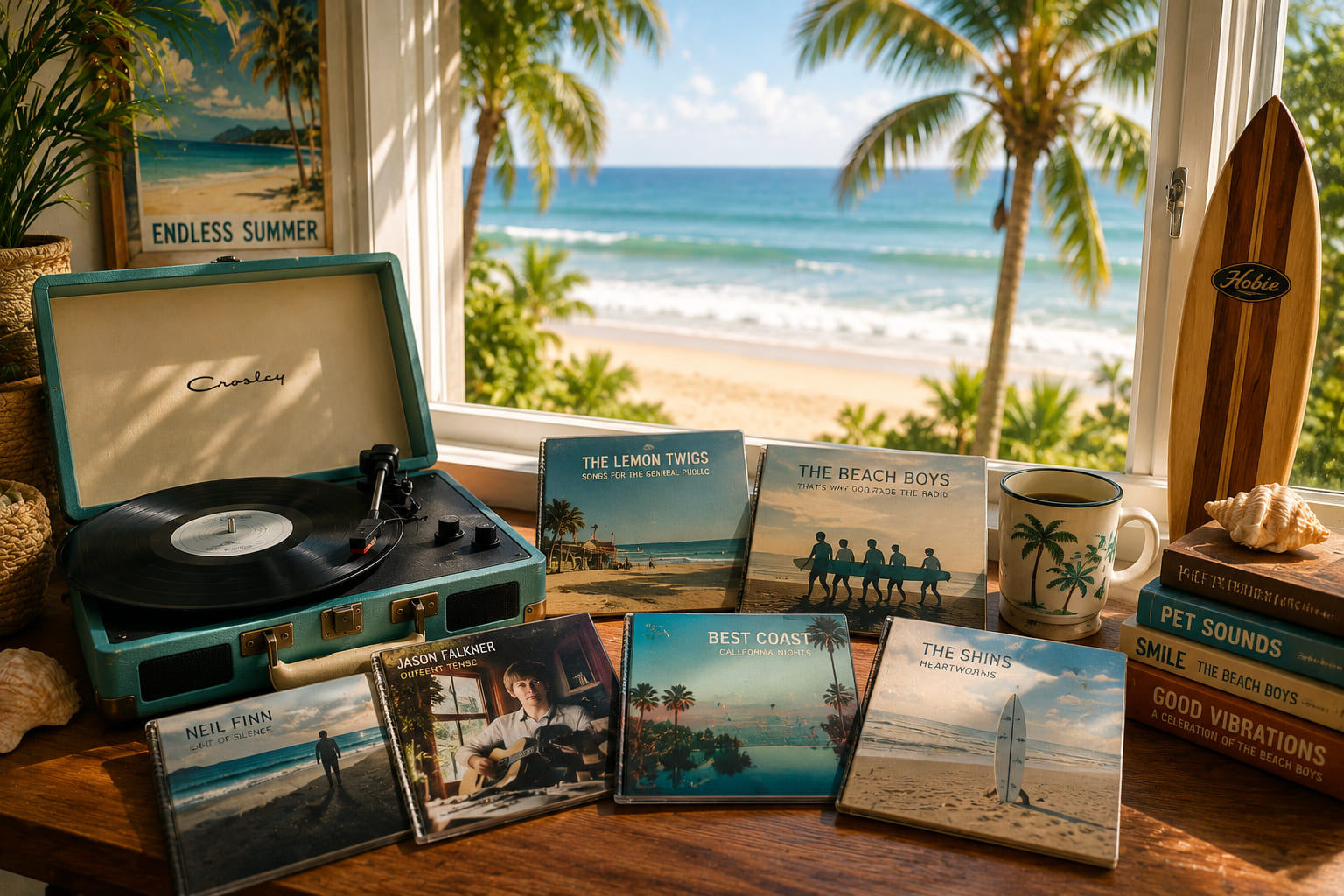
Looking for modern music that resembles the Beach Boys can lead to disappointing recommendations. Some artists copy the stacked vocals but miss the emotional writing. Others recreate surf guitars while ignoring Brian Wilson’s adventurous arrangements. The better approach is to identify which part of the Beach Boys you want to hear again.
Their catalogue contains several musical identities: early surf and car songs, the inward-looking pop of Pet Sounds, the modular experiments around Smile, and the softer, stranger records that followed. The albums below connect with different parts of that history without functioning as simple replicas.
The Explorers Club — Freedom Wind
This 2008 album is the clearest starting point for listeners who want close vocal harmony, bright chord changes, and carefully placed percussion. The group understands that the Beach Boys sound depends on arrangement, not merely falsetto. Horns, keyboards, handclaps, and layered voices enter at specific moments, giving each chorus a sense of arrival.
Start here if you prefer the warmth of “Wouldn’t It Be Nice,” “Don’t Worry Baby,” and the group’s mid-1960s singles. It also makes a useful companion to our guide on why some pop songs feel like summer, because it shows how modern musicians can create seasonal brightness without relying on novelty lyrics.
The High Llamas — Hawaii
Sean O’Hagan’s arrangements often draw more from Brian Wilson’s harmonic imagination than from the Beach Boys’ vocal image. Hawaii, released in 1996, is full of soft brass, vibraphone-like colors, intricate keyboards, and melodies that drift through unexpected chords.
This is not a direct surf-pop record. It is better for listeners fascinated by the instrumental detail of Pet Sounds and the unfinished possibilities of Smile. Give it time. The album reveals its design gradually rather than presenting every hook immediately.
Panda Bear — Person Pitch
Noah Lennox uses repetition, samples, and massed vocals to create a different route back to Brian Wilson. The voices are often blurred into the production instead of separated into traditional harmony parts. The result feels devotional, aquatic, and modern.
Choose this album if you respond to the spiritual quality of songs such as “Our Prayer” or the more experimental side of the Beach Boys. It demonstrates how their influence can survive even when the instruments and recording methods change completely.
Fleet Foxes — Fleet Foxes
Fleet Foxes connect Beach Boys harmony with folk, church singing, and spacious acoustic arrangements. Their 2008 debut uses vocal unity as a structural tool: harmonies answer lead lines, widen choruses, and create a sense of shared space.
The resemblance is strongest in the care given to voicing and emotional tension, not in California imagery. The Recording Academy has noted the Beach Boys’ broad influence across later generations, including Fleet Foxes. This record suits listeners who want the harmonies in a more rustic setting.
Tame Impala — Lonerism
Kevin Parker’s second album takes the inward mood, psychedelic color, and studio-as-instrument thinking of late-1960s pop into a modern home-recording context. Synthesizers and compressed drums replace much of the orchestral language, but the emotional perspective remains familiar: private uncertainty presented through expansive sound.
Beach Boys fans who value Brian Wilson’s ability to turn isolation into melodic pop may find more common ground here than listeners seeking exact vocal imitation.
The Lemon Twigs — Everything Harmony
The title is accurate. The D’Addario brothers build songs around close singing, acoustic guitars, carefully shaped melodies, and soft-rock detail. The album’s influences extend beyond the Beach Boys to the Everly Brothers, Simon and Garfunkel, Big Star, and 1970s singer-songwriters.
What makes the record work is discipline. The harmonies support songs that would remain strong if played on one guitar. This is essential: Brian Wilson’s arrangements were ambitious, but they were attached to memorable melodic and emotional ideas.
Drugdealer — The End of Comedy
Michael Collins approaches 1960s and 1970s pop through a relaxed Los Angeles lens. Piano, soft percussion, flute, guitar, and guest vocals create an easy surface, while the songwriting frequently turns reflective. The album is useful for fans of the Beach Boys’ gentler early-1970s work and the broader West Coast studio tradition.
Weyes Blood — Titanic Rising
Natalie Mering’s 2019 album combines large melodies, layered vocals, strings, keyboards, and a modern sense of environmental and personal uncertainty. It does not sound like a Beach Boys tribute, but it shares an important principle with Pet Sounds: intimate worries can support grand arrangements.
The Library of Congress describes Pet Sounds as a carefully planned, unified album rather than merely a collection of singles. Titanic Rising rewards the same kind of full-album listening.
Choose by the quality you value most
- For classic vocal sunshine, begin with Freedom Wind.
- For orchestral detail, try Hawaii or Titanic Rising.
- For experimental vocal texture, choose Person Pitch.
- For folk-based harmony, start with Fleet Foxes.
- For psychedelic isolation and studio craft, play Lonerism.
- For tightly written modern harmony pop, hear Everything Harmony.
The Beach Boys remain difficult to imitate because their best records combine several strengths at once: melody, vocal architecture, unusual instrumentation, rhythmic clarity, and emotional vulnerability. Modern artists are most convincing when they carry one or two of those ideas forward in their own language.
Use these albums as paths, not substitutes. Returning to the Beach Boys after hearing them often makes familiar recordings sound newly detailed, because you begin to notice which ideas later musicians chose to preserve.