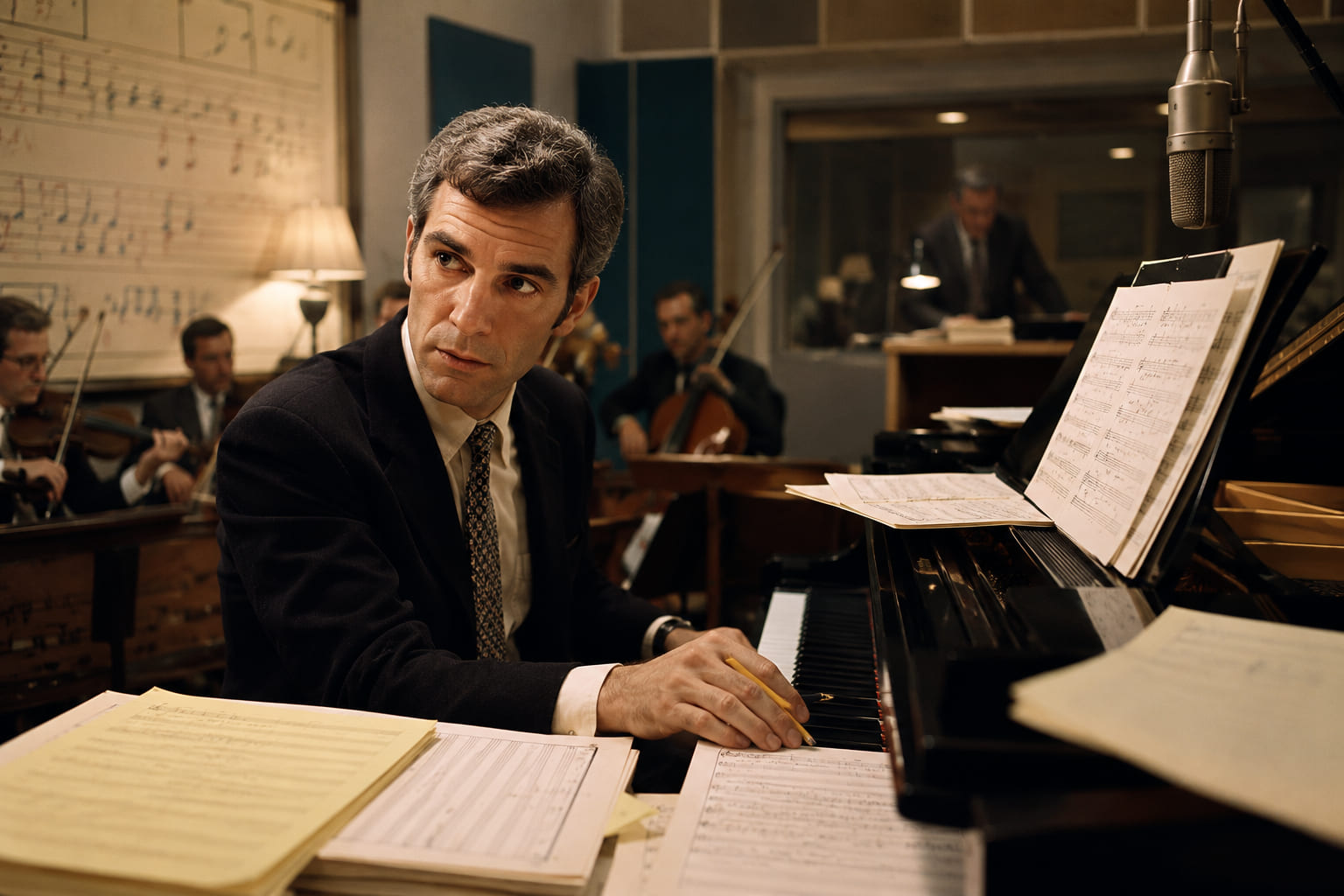
Burt Bacharach wrote songs that entered popular memory without behaving like ordinary pop songs. Their melodies are graceful, the arrangements polished, and the hooks immediate. Under that surface, meters shift, phrases arrive at unexpected lengths, chords avoid obvious routes, and instrumental lines compete gently for attention.
That combination explains why his work can sound easy while remaining difficult to perform. Bacharach did not use complexity to distance the listener. He used it to make conversational lyrics feel more human: hesitant, interrupted, hopeful, and emotionally inconsistent.
He treated the singer’s breath as part of the composition
Many pop melodies fit neatly into repeated four-bar phrases. Bacharach often allowed a lyric to determine a less symmetrical shape. A phrase might stretch because the thought needs more space, then shorten sharply to create emphasis.
This approach is especially clear in songs associated with Dionne Warwick. Her control, range, and rhythmic precision allowed melodies to cross bar lines and change direction without sounding academic. The vocal line can feel like speech refined into music.
When listening, avoid counting at first. Follow where the singer breathes. Then replay the song and notice how the accompaniment adjusts underneath. The irregularity often feels natural because the lyric and melody agree.
Changing meter became an emotional tool
Bacharach is famous for using unusual and changing time signatures, but the important question is what those changes do. They may extend a moment of anticipation, remove a beat to create urgency, or make a familiar refrain feel briefly unstable.
“Promises, Promises” is a strong example of rhythmic design that remains energetic rather than mathematical. “I Say a Little Prayer” creates motion through layered rhythmic patterns and phrasing that resists a square, predictable pulse.
The lesson for songwriters is not to insert odd meters for novelty. Change the length of a phrase only when the emotional sentence benefits. Bacharach’s rhythmic surprises usually sound inevitable after you know the song.
His chords moved with elegance and risk
Bacharach’s harmony draws from jazz, classical music, Broadway, and the language of mid-century popular song. He often used chords that reframe a melody rather than simply support it. A note can sound settled over one chord and newly vulnerable when the harmony changes beneath it.
He also understood cadence: the point where harmony creates or delays a sense of arrival. Many of his songs postpone a comfortable resolution, which keeps an elegant melody from becoming passive.
This harmonic intelligence connects his work with the baroque and chamber-pop traditions discussed in our sunshine pop versus baroque pop guide. The difference is that Bacharach’s vocabulary extends beyond a rock-band framework into orchestral pop, jazz, film music, and theatre.
The orchestra behaved like a cast of characters
Strings, brass, piano, percussion, and woodwinds do not merely thicken Bacharach’s recordings. They answer the singer, introduce hooks, interrupt phrases, and change the emotional temperature. A flugelhorn line may sound reassuring; a sharp piano figure may create nervous energy.
The Library of Congress notes that Bacharach trained at McGill University and studied with composers including Darius Milhaud and Henry Cowell. He later worked as composer, pianist, arranger, orchestrator, and producer—a rare concentration of roles in pop.
Because he understood the whole recording, he could write instrumental detail that belonged to the song’s identity. Remove the opening figure from “Walk On By” or the rhythmic character from “Do You Know the Way to San José,” and you remove part of the composition, not decoration.
Hal David supplied plain words for complex settings
The long partnership between Bacharach and lyricist Hal David depended on difference. David often wrote direct, conversational language about love, distance, doubt, and public life. Bacharach could then place those words inside sophisticated musical structures without making the lyric feel inflated.
“Alfie” demonstrates the balance. Hal David’s direct question gives Bacharach room to build a long melody whose harmonic turns deepen the lyric without making it feel inflated. The Library of Congress documents Bacharach’s broad work as a composer, arranger, conductor, and producer.
Dionne Warwick made difficulty sound inevitable
Bacharach and David’s songs are inseparable from Dionne Warwick’s interpretations. She could maintain clarity through changing meters, wide intervals, delicate entrances, and long phrases. Her delivery rarely advertises the technical challenge.
This is a form of expertise listeners sometimes overlook. A difficult song performed well may sound simpler than an ordinary song performed badly. Warwick’s precision allowed emotional nuance to remain in front of technique.
Six songs that reveal the craft
- “Walk On By” for instrumental counter-lines and controlled heartbreak.
- “I Say a Little Prayer” for rhythmic layering and vocal phrasing.
- “Promises, Promises” for changing meter with forward momentum.
- “The Look of Love” for space, sensual pacing, and orchestral color.
- “Alfie” for a melody that develops like a complete dramatic statement.
- “A House Is Not a Home” for simple language supported by sophisticated form.
How to listen like an arranger
Choose one song and play it four times. First follow only the melody. Then listen to the bass. On the third play, note every instrumental response after a vocal phrase. Finally, try to clap a steady pulse and notice where the phrase length challenges your expectation.
The exercise reveals why Bacharach remains relevant to modern pop writers. His songs prove that accessibility does not require predictability. A listener can remember the hook immediately while continuing to find structural detail years later.
Bacharach’s greatest skill was not complexity by itself. It was hospitality. He invited unusual harmony, meter, and orchestration into popular songs, then arranged them so clearly that millions of listeners felt at home.