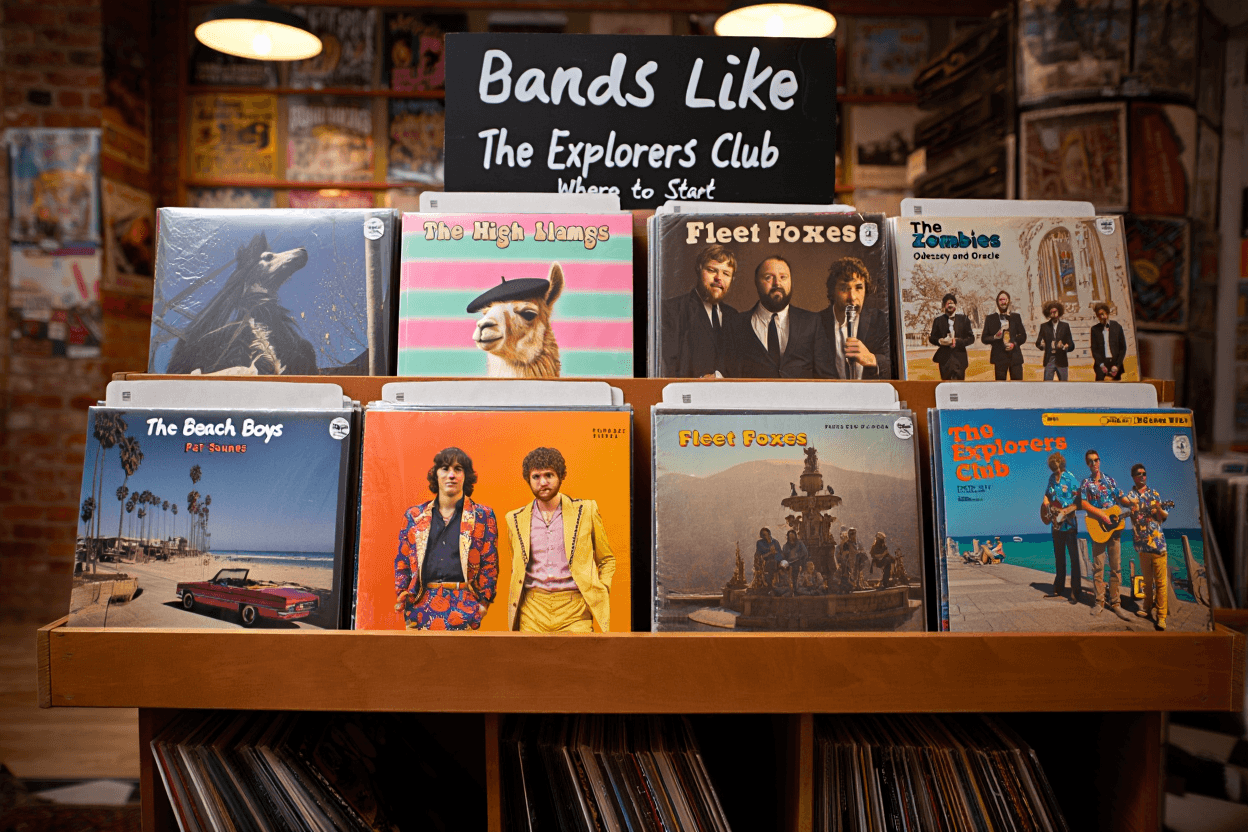
The Explorers Club sit in a specific lane of retro-inspired pop. They are not simply a band with old influences. Their records point toward 1960s vocal groups, soft pop, surf-adjacent melodies, and the kind of studio craft associated with Brian Wilson, Curt Boettcher, and classic harmony pop. Anyone searching for bands like The Explorers Club is usually looking for music that feels melodic, arranged, bright, and slightly out of time.
A useful first step is to understand the band's own background. The Explorers Club are commonly described as a South Carolina retro pop group, and their album history includes Freedom Wind, Grand Hotel, Together, The Explorers Club, To Sing and Be Born Again, and Wattage. A basic discography appears in Wikipedia's page on The Explorers Club. Their early sound was often linked to Southern California pop and Beach Boys-style arrangements.
The most obvious reference point is the Beach Boys, especially the period around Today!, Pet Sounds, and Sunflower. The connection is not only about surf imagery. It is about stacked harmonies, bass lines that sing, and arrangements that use small details to create movement. For more genre background, start with our earlier guide, what is sunshine pop, because many Explorers Club comparisons come from that same family of sound.
The High Llamas are another strong match, though their music often leans more into chamber pop, bossa nova, and film-score textures. Their work is useful for listeners who enjoy the softer, more arranged side of retro pop. The High Llamas' background explains their long connection to chamber pop and Beach Boys comparisons, while also noting broader influences such as European soundtracks and bossa nova.
The Lemon Twigs offer a more theatrical and restless version of the same retro impulse. Their music has been noted for roots in 1960s and 1970s pop and rock, including power pop, glam, art rock, and jangle pop, as summarized in their Wikipedia profile. They are a good recommendation for listeners who want the melodic density of old pop but with more dramatic shifts and a younger indie-rock edge.
Fleet Foxes are less directly connected to surf pop, but their vocal arrangements make sense in this listening path. Their first records use group harmonies, folk-rock movement, and a sense of open space that can appeal to fans of harmony-first pop. They are not a one-to-one comparison, but they show how older vocal traditions can return in a modern band without sounding like museum work.
The Zombies also belong in the conversation, especially for listeners who like elegant chord changes and bittersweet melodies. Their 1968 album Odessey and Oracle remains a key reference for melodic pop that is arranged, concise, and emotionally strange. It is not sunshine pop in the cleanest sense, but it shares the same belief that pop songs can be compact and sophisticated.
The honest answer is that no single band replaces The Explorers Club. Their appeal comes from how directly they work inside classic pop language. But that also makes them a useful starting point. Move toward the Beach Boys for the source, the High Llamas for chamber-pop refinement, the Lemon Twigs for modern retro energy, Fleet Foxes for harmony-centered songwriting, and the Zombies for melodic intelligence. Together, they form a map of the sound rather than a simple list of similar names.